Persephone Abbott

Reflections in Germany 2025

Posted on May 2, 2025

I recall the coolness the moment I stepped into the hall, and I remember the odor of wood polish. It was July and I was seventeen. 

I might have looked like I had a lot going on, but I didn’t. Coming from the north by car, I was deposited into the care of my father’s German translator by my American Field Service host and hostess who didn’t quite know what to do with me. 

Tecklenburg had been a strain. It was a small and cosy town on a hill with a medieval ruin in Westfalia. A theater had been set up between the walls of the former castle. Along with the members of my host family, I stood on stage in the rain dressed in a Hungarian costume and sang the choir’s soprano line in the summer season’s production. A syrupy operetta entitled “Der Zigeunerbaron” topped the bill.

In Munich, I discovered that my father’s German translator and his wife were people I could easily relate to and they didn’t expect me to act like a teenager. I wasn’t interested in teenager things. I wanted to pound city pavement and stare at the kind of architectural wonders that are not found in California.

So instead of watching episodes of Hertz zu Hertz in German on a hill in Westfalia, I stood observing the shadows falling around the beam of light that hazily pieced through the windows of the old apartment building on Daiserstrasse. The lightness and darkness and browns and greys shifting softly and silently over the staircase at the back of the wide hallway. It was summer and it was hot and the staircase was polished and cool. 

Just once I would love to stand there again.

“I’ve got an appointment,” Ilse said to me. She doesn’t live in Munich anymore. They moved to a university town outside the city and their building’s hallway smells satisfactorily of wood polish. Whenever I enter, I always take a moment to inhale deeply and relax.

Ilse explained she had decided to get her teeth straightened. I got her point, but I thought with regret that had she had her teeth straightened when I first met her, I would never have thought of her as uniquely European. Then again, she’s nearly eighty and she wants her teeth to look better assembled. She feels it’s about time. It’s quite understandable.

Spring is advancing and summer is coming, and the landlord’s tidy garden surrounding my father’s translator’s flat has turned a hearty and lush green. And I love the summer time in southern Germany. I love it when it gets warm, the birds sing and I listen to Bavarians speak about bike tours and the weather. It’s always a vacation, a real vacation.

*

Dreaming of an Impossible Strawberry in Germany

Ruminating that
I’ll have to fix that
when I woke up that
small unripe strawberry
its twisted white-ish
bottom quite incorrect
that
that
then
whoosh
out of
my reach

*


I Thought of An Ex-Friend While in Freising DE

a bloody pinkish red
concentrated vitamin juice
travel sized bottles in bottom bin
- nearly lying on the floor -
the overflowing drugstore has everything

last time, that was the last time
I was collecting unique items
as advent calendar gifts
like, much appreciated,
my friend in America
had previously sent me

then, well back then you know
it was the time of corona so when
the empty plane landed in Seattle
I proudly presented
- all wrapped up -
the vitamin concentrate, and of course
twenty-two other small Bavarian treasures plus
a first edition 1930-something novel
a female French author to be sure
hardbound and last minute addition to be sure

my friend tucked the Advent bag away, turning to
the closet nearest her, saving it for the coming yuletide
- her dog nipped at me -

I thought I was doing okay
definitely not well off
- basically......you might say....comfortable -
I fancied maybe a handbag
such as my friend kept
on her kitchen counter
only days later to learn
a price tag for thousands of dollars
hung on it, even when second hand
and it was second hand

what was it again?
her dog nipped at me
reminds me now:
the small candle both
donation and token for a prayer
sourced at a Baroque church in Passau
I thought my ex-friend would
particularly enjoy
being Catholic and all

Some days I imagine my ex-friend on a loop
chucking the whole bag of Advent items into a box of old clothes,
driving it out of her driveway in the trunk of her white BMW
and handing it over to the folks
at the Salvation Army
or the Goodwill
she didn’t need me
like I needed her

we don’t talk anymore
from social media postings
I see she still has her dog

Artistic License

Posted on April 20, 2025

Cleaning up my social media this week, I came across the name of a French baritone in my list of friends.

Jacques Calatayud was a devoted friend to Suzanne Sarroca (and her former student) and he had died. And so had she. They died within a year of each other. I had no idea.

In 2015 I met up with both of them for dinner in Paris. Sarroca was already quite in advanced age, still living in her apartment on the rue Notre Dame de Lorette, and Jacques was attentive to her needs. He screened the diva’s socializing activities and facilitated the meeting with Sarroca. I remember him as a very gentle and kind person. 

“You are lucky,” Sarroca said to me over dinner, “you can do other things than just sing.” Her words were kind, but she knew me well and recognized that I did indeed have other occupations than singing that I genuinely liked. 

Jacques was her prize student. “Il tourne,” she said proudly. Meaning that he had solidified a career in the opera world. He routinely sang secondary roles on major European stages, and occasionally primary roles. 

I remembered the conversations that I took part in and witnessed while I studied in Paris with two celebrated sopranos, Suzanne Sarroca and Mady Mesplé. Years later I wrote the conversations down, verbatim. They are part of a bygone era, yet in a way the social mannerisms revealed in those conversations are still valid in the operatic world today.

Other than the diva’s names in Idle Opportunities, nothing else changed about the ladies. Not their words or their attitudes or their homes….but written from, of course, my then perspective as a twenty something year old.

Side note: Sarroca’s beloved dog Polka was renamed Mazurka.

Although I remember both Sarroca and Mesplé as fierce, loving and regal in their own ways, primarily I was Sarroca’s student. I am grateful to have experienced Paris with her as my main teacher and guide.

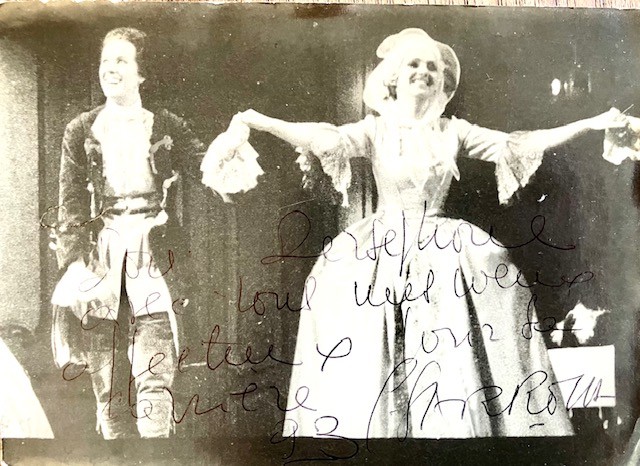
Suzanne Sarroca (left) as Octavian in RosenKavalier

Some thoughts while transcribing my father’s memoir on his acceptance of Zen Buddhism and his relationship with Kobun Chino Roshi 

Posted on April 12, 2025

I was, by all means, skeptical. My father had never shown any interest in organized religion, but there he was in front of me in his study in Longmont, Colorado. He was talking to me about sewing up his little pouch and explaining how my mother had helped him. 

This was possibly a few years after his refuge vow ceremony which I missed. At the time I had been in the process of moving from Singapore back to the Netherlands. I don’t recall if I actually had been invited to witness his vows. It seems to me that I had been told about the occasion and was, in some way, expected to show up. Didn’t I understand the importance? 

In years prior to Keith’s refuge vows, I had reconnected with my maternal family and, right along with my mother, Keith had been adamant that this was something I should not be undertaking or do. Yet I did it. And in the midst of all the years of trauma that I had absorbed and time and energy spent to find resolution for my own mental health and interacting with the family members who loved me and then the endless attempts at conversation and acceptance with my parents about my decision as an adult, here Keith was looking at me right in the eyes and speaking about his Zen paraphernalia. To me, he was running away into Zen Buddhism and shutting the door. 

The whole scene was like a bad joke. My mother had already developed a fantasy about being Sami and was taking it as far as she could (later she wove another tale of being Jewish into the mix) and my father was going Zen. He even got a name, Bear Sage. I was appalled. After all the shit I had been through, here my father was now entitled with his sanctified name: Bear Sage. During that visit to Longmont, perhaps it was my last visit to their house, I laughingly let drop that my husband, who was a diagnostic specialist of rotating equipment and both considering and given that my father was now Bear Sage, should be called Gear Sage. As an engineer my husband travelled the world because there were not many who could do the type of work he was able to provide.  Keith was not amused at my own take on matters.

So what was this Zen idea? Was it to gain clout at Naropa or….jurisdiction over me? Was it to find friendship and a buddy or buddies? Was it to tamp down his issues with drug addiction? Was it to escape the madness at home? Was it a protective layer that would give him some space since my mother had landed that disability check and sat at home all the time thinking up storms to unleash on humanity?

But in the end Zen Buddhism was my father’s chosen family and present for him as he lay dying. 

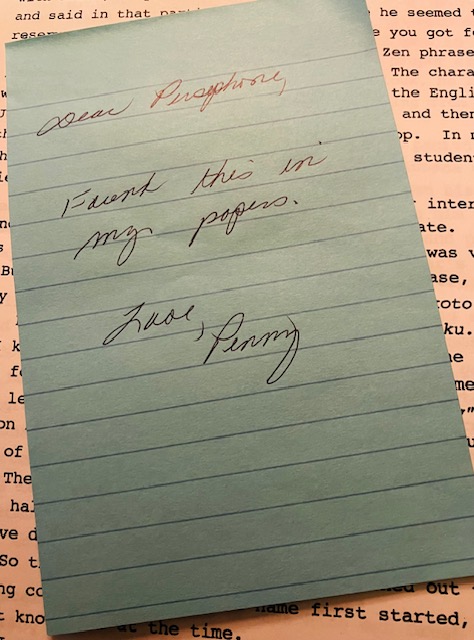
I freely admit that when I was sent the fifteen pages of the memoir that Keith had given Penny, I sighed in exasperation and cursorily read through the pages. But after noticing that there are several sites online that mention the link to Keith’s old website and the memoir, I thought I would add it to the website I manage for Keith’s works. If anyone was looking for it, it might as well be accessible. 

It’s not about me. I was never able to develop a relationship with my father as an adult. The joys I remember are from the times we shared back in the 1970’s and 1980’s. And reading Keith’s words, I am genuinely happy he got to engage and connect with Kobun. I find it ironic that Kobun lost his life trying to save his daughter and, after Keith’s death, I have been trying to save my father who certainly never tried to save me. For years I was angry at this, and then I came to realise that Keith could never have saved himself from his fate. But in the meantime he did seek out various manners to enjoy and make sense of his life. At least Keith can’t take me down with him.  That’s the Zen of the matter.

Paradise

Posted on March 31, 2025

I had thought about it. The American Photography exhibition at the Rijksmuseum. Then my phone via Facebook or Instagram or Osmosis-Goo suggested that I seriously consider buying a ticket, like right now, click the link and chakka-gotcha! The Rijksmuseum sits just around the corner from my apartment, a five minute walk. Motivated, I took the bait.

Walking through the exhibit at 9 a.m. on a Monday morning, I thought about my age. From my memory bank I can understand the subject matter in the photographs, either because I was already born or my grandparents were alive during the early to mid 20th century era or because the historical photographs of locations were still somewhat recognizable to what I recall seeing when I lived in the states.

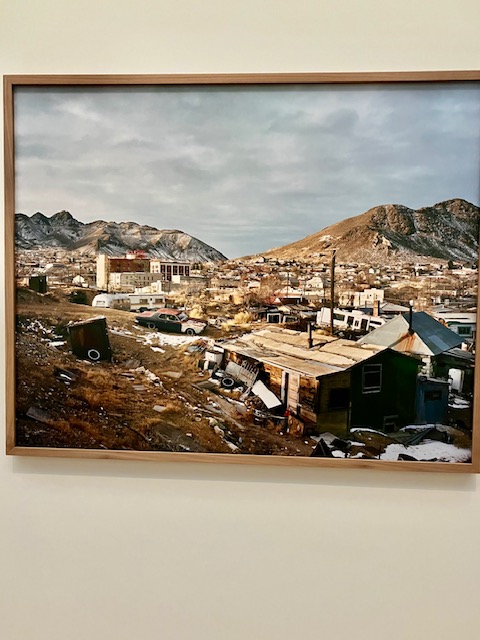
I stood for a while in front of Schutmaat’s photograph of Tonopah, Nevada.  To my eyes, the photo of Tonopah Nevada was extraordinarily beautiful. Soothing in a way. I examined the old bed frame leaning against the back of a house. The bed frame dated from the early 20th century and it was ending its functional existence behind the house. The mining frenzy had enticed people seeking riches and good fortune and then left them, much like the bed frame, stranded in the high desert landscape. Dreams diminished, their momentum exhausted by dry winds and blue skies. Every object in the photo of Tonopah Nevada presented itself as a carefully chosen and strategically placed detail in a picturesque junkyard, even the houses loosely spread over the hills. Chakka-gotcha!

*

My father was a poet in residence in Nevada in the late 1970’s. He once took me with him on the road to keep him company. He drove the vinyl roofed Ford Maverick over the Donner Pass one spring day and we listened to Ry Cooder on an 8-track tape. I spent a week with him and I can’t remember which exact town he was teaching in or what school we visited that particular week, but his students were in middle school. I was eleven and still attending elementary school and I have no idea why I was not in school myself, but it was logical to me that spending time with Keith was more important than attending elementary school. That was the way things rolled back then, school break or no school break.

My father had a fascination with Nevada. Many of his stories touch on the subject matter. He didn’t want to end up in Nevada, though. I recall him nudging me away from a plate of saltines spread with honey and peanut butter, the local special treat whipped up as part of the going away party for the exotic poet-in-residence, and throwing his briefcase into the trunk. “Let’s go!” he said silently with a jerk of his head. Then he drove with determination, both meaty fists on the steering wheel of the Ford Maverick back over the Donner Pass. We listened to Ry Cooder on the 8-track tape deck, looping around and around, snaking down out of the Sierra Nevadas, shifting gears and gliding back into the foothills of California. 

*

Paradise, Nevada a short story by Keith Kumasen Abbott

__

Why, you come all the way out here to see me, Flipper Dipper? Well, I appreciate it, and it sure gives me a chance to thank you for something. Hey, you remember when I came by your shack in Monterey? When was that? About 1971? Flipper took your advice. Got myself an old Chevy truck. 

That’s what you said to do. You said that guy can always get parts for an old Chevy truck.You were right. Look over there. That’s the truck I got. 

You remember Shalon, that red headed girl? She was with me when I stopped by your shack and you told me to get a truck. She was something. Shalon was. See that plastic bubble on my camper? She stole that. Picked it up and walked right out of the junk yard with it. 

Shalon, she was something. 

I rebuilt this truck and that camper with her help. Stole everything I needed. She was eighteen. Eighteen! And brave? Once she picked up two truck tires that were on display at Sears and took a hike with them. There wasn’t nothing she wouldn’t do. 

We had a time. Drove up and down the coast. We didn’t miss much. Never had any trouble with food, not with Shalon along. Had a poncho with slits on the side, her hands could snake out of there and zap! Sirloin on the barbeque tonight! 

You know the NCOs used to talk about Korea, talking about some peasant walking off the Aray base with a jeep engine on his back. That was Shalon. She would have done it for me. Always had an eye out. Hardly a day went by when she didn’t come in with something.  

Right before she left me, she was getting so good at head that I gave up giving her any instructions, and just let her tend to her own inventions. Damn near drained the color out of my hair. 

You know……before we drove this truck to Nebraska in 1974 and harvested a whole load of marijuana. It was growing on the back acres of an uncle of hers. Couldn’t even sleep in the camper, had so much reefer in there. We bunked on the ground beside of the truck coming back to the coast. 

That truckload of boo floated us along there for over a year. Up and down the coast, rock festival to art festival to god knows what.  Man, those were the years!

Funny you showing up here. Gar gave you the Flipper’s PO Box? Yeah, that’s what I thought. Gar gave me some help with upping my vet disability. Shrapnel kept showing up. In my chest. I came out to the desert ‘cause it dries me up. My skin. And the stuff works out easier, somehow. Still picking metal out of my tits. 

I get along. Didn’t mean to end up here but the truck broke down and this was the end of the road anyway. Look down to the end of that street. Boom town. Old bakery, those brick walls the saloon, that’s the bank building and then nothing. Now that’s the real end of the road. Nothing but desert and jeep trails beyond that. That’s Paradise’s city limits, where the street just stops. 

Forestee service trails and that’s who I work for now and again. Forest-tee service, I can’t stop calling it that. No forests in this part of Nevada, dinky scrub trees, not real forests. Toy forests. Still have half my head on the coast, I guess. 

Paradise here has a post office, that’s all I need or want. Get my checks, stay put. You ever get back up to Washington, I heard Shalon is there now. Outside Seattle, Issaquah or Stillaguamish. You see her, tell her old Flipper Dipper’s here. I bet she’ll laugh when she hears that. 

Flipper’s between McDermitt and Winnemucca, that’s all you have to say.  Don’t say more than that. I don’t suppose she knows where Paradise is. Just say between McDermitt and Winnemucca – she if she don’t laugh. 

At the Rijksmusem exhibit American Photography, Tonopah Nevada by Schutmaat

Worms Riding the Air Waves

Posted on March 26, 2025

He opened up a ledger book. The ledger book looked familiar. Somewhere at my grandmother’s house on the outskirts of Tacoma back in the 1970’s I’d seen one that, it seemed to me, now appeared to have been transported to Amsterdam. I was standing in a narrow and crooked building that had been constructed in the 17th century. It was presently a tourist shop and a UPS pick up point. It was my third attempt at collecting my parcel.

“You must file a police report.” The instructions from the Amazon-Ready-Set-Answer department were clear. 

My question had been, “Where is my package?” By this point I had already been to a designated pick up point twice. 

After two attempts at the pick up point, I read that my package had somehow been “delivered” to my own address, I contacted Amazon who insinuated that I was engaging in fraud. A police report? It wasn’t as if my package could have been stolen from my front porch. Because, not being a 17th century house with a staircase and front porch, there is no front porch to my apartment building.

I imagined myself at the police station, insisting to a staunch Amsterdam police person that I must register a theft because UPS left a package on the street. Something told me that even if the side of me that is one heck of an ornery ex-opera singer got really riled up, I still wouldn’t walk away from the police station with a document that would suit the powers that be at Amazon and prompt a refund. 

Eventually I was told that the first pick up point, a 17th century house turned tourist shop and a UPS pick up point, was not THE exact 17th century house where my alternative electric toothbrush had been delivered.  I was told that I needed to go to a different 17th century house turned tourist shop and UPS pick up point.

The man leafed through his ledger. “Which date was it delivered?” he asked, after telling me that without the barcode I couldn’t pick up the package. UPS hadn’t sent me a barcode. I only had a tracking number. And as far as Amazon was concerned, I had already received my package.

But luckily for me, this grumpy businessman wrote all the packages he received down in a ledger book. Handwritten and old style and organized by last name. 

Later that day I was sitting at lunch with a married couple. Their family had endured the Holocaust.  

“Do you know someone who has been detained?” they asked.

I had just heard an acquaintance relate how her friend had been detained in the states, denied entry and then deported to France. 

We sat in silence for a moment. In my mind, the world before my eyes turned grey and fuzzy and the waves worming frantically in the air took me to a place I had never visited.

Pilgrimage

Posted on March 16, 2025

Reading Shakespeare and drinking tea are pleasant occupations. And drinking whiskey and reading Shakespeare are also pleasant occupations. A friend of mine and I meet up every so often and read a play together. We switch the parts freely. She’s a health care professional and during the break between transitioning from the tea to the whiskey part of the evening she said to me, “You know, living with a narcissist ages a person.” She meant literally ages a person physically, mentally and spiritually. I remembered  myself at the age of seventeen when I couldn’t recall what I had done an hour previously. I wasn’t taking medication, I wasn’t under the influence of any substances. In despair I dyed my hair grey for a period of time in highschool. Outwardly, I’m now guessing, I seemed to be managing to put one foot in front of the other back then, but inwardly I was drowning. I got away from the narcissist dominating my childhood home, pulling myself hundreds of miles across the globe, and I became hyper aware these past few years that in doing so I saved my own life.

*

Before meeting up to read Shakespeare I spent the week editing my father’s short story that he wrote on the time he introduced Ken Kesey at a reading. The draft that I had received, by the grace of whatever universal energy was present via the nephew of a friend of my father, was twenty-eight pages long. The print out date was July 12, 2012. That would be six years before Keith’s death. Considering that I have edited Racer for publication (TBA publication date) and put together a retelling of Mordecai of Monterey (both novels were written in the early 1980’s), the difference in the writing is evident. My parents spent fifty odd years together, so the question arises: Whose language and use of words belonged to whom? Pausing frequently as I edited my father’s story about Ken Kesey, I could tell where a certain idea had been supported or reinforced by my mother because of the words my father was selecting. I downplayed those ideas as I edited or I removed the toxicity entirely. At times it was heartbreakingly obvious that in 2012 my father’s impeccable logic was already failing him, but in all fairness this was a draft that I was reviewing. I freely rearranged the paragraphs to sort out his ideas. “It’s living with chronic stress and trauma,” my friend reminded me. Yes, and living in a “land” where time evaporates into thin air.

I finished the final blog posting (the short story is now a five part series of postings on my father’s website) on Saturday night just in time to pull on some layers and head out the door. I had heard about the Stille Omgang when I recently took part in an architectural tour and remembered the date. March 15th. Glancing at the websites that were promoting the event, I couldn’t quite figure out what exactly was expected from the participants. I knew there would be a procession, and it would be a Catholic procession in a Protestant country.

*

The temperature outside was just above freezing as I made my way to the place where the procession would start. We entered the church. “Of course,” I said to myself, “first thing on the agenda: a church service.” By the end of the mass I felt myself uplifted by the final hymn which I recognized from my experiences in the Protestant Church. It was as if a gloom had been lifted from the brow of every person present. 

Now ready to venerate the miracle (for which the priest had instructed the congregation, “Our faith is in the mystery. It never makes sense and that is the radicality of Catholicism,” and right then, duly noting that silently deliberating the miracle while sitting in my pew would be a waste of my energy, I decided not to think too deeply about the matter and go wih the flow), we gathered outside to begin the re-enactment of the medieval tradition. The manifestation of the miracle was witnessed in the year 1345 and the gist is that as a man lay dying the sacrament had not burned. Okay, so the moribund was given the final sacrament whereupon he vomited the Body of Christ which was then thrown into the fireplace and later, upon inspection, the Host was found intact and without any traces of incineration. 

Catholic processions were officially banned after the Reformation in the Netherlands. Therefore, the ones that did manage to exist, supposedly after the ban was lifted, and the few that still remain are often called “Silent Processions”.  My curiosity was killing me. We exited the Begijnhof and started making our way up the Kalverstraat. Like most of the world, retail shops are falling under hard times and many of the stores on Amsterdam’s “high street” are stripped empty. Adding to this malaise is the fact that the apartments above the shops are mostly devoid of inhabitants. The entrances and stairways to the former homes of people were removed in the mid-late 20th century to make way for more shop space, enriching real estate transactions in the area. It’s a thorn in the side of the city now and there are various movements to reinstate citizens in the apartment spaces. 

We passed the site of the Miraculous Wafer, presently the location of the Dungeon Museum. I had hoped that we would be allowed in the chapel that still exists within the museum but, unfortunately, this was not the case. We continued along the narrow shopping street, passing more empty, boarded up shops and darkened buildings. Drunken tourists around us yelled and sang, “This girl is on FIYAH!” in the streets while participants of the Stille Omgang tried not to engage in conversations with each other. This was difficult. I was beginning to sense a whiff of Catholic martyrdom sincerely floating in the air. We crossed the Dam and continued up the Nieuwedijk where, again, many shops were closed and above the shops hung the unlit windows in the building facades.

*

Amsterdam’s Central Station was now in our sights. We turned right. “Are we heading into the red light district?” I wondered. After all, by this time, it was almost 11 p.m., and the place was jumping on a Saturday night. The red light district was once the heart of the medieval city with multiple convents and monasteries but that all ended roundabout 1585. That was quite a while ago. We wandered down the Warmoesstraat. I could feel the mood in the group plummet a bit. The street scene was a complete reversal of the serious business of the church service. Despite the rosaries dangling from fingers, it was proving hard work to keep up with the appearance of a holy pilgrimage without having the option to make any noise. 

“Is the Gooi still a very Catholic place?” someone inquired softly behind me to their friend as we exited the Warmoesstraat. “No? Maybe Bunnik?” It sounded more like a hopeful proposal. 

Returning to the site of the Miracle, we circled the Dungeon Museum and then we stopped at the corner. The group I had joined at the beginning of the evening was coordinating the liaison with their tour bus. They had come in from Den Bosch to take part in the commemoration of the Miracle. 

I walked back to my apartment. Oddly enough as the procession had made its way down the Nes, I had a strange feeling of retracing someone else’s steps.

She Put Me On X

Posted on March 12, 2025

Keith sighed and looked down into his beer.

Sitting next to him in Beer Springs

his good buddy asked what the matter was.

“She put me on X.”

“Who?”

“Persephone.”

“Well, you named her.”
Persephone Abbott and Keith Abbott

Don’t miss out and check out Routine Apparitions….or X

At the Circus

Posted on March 4, 2025

“Ah,” I thought to myself, sitting comfortably in my assigned seat at Le Carré in Amsterdam.  It was a very nice seat at the back of the royal “loge” section in what used to be the circus theatre. The theater is no longer the home of the circus. 

*

A few years ago I heard Mavis Staples at Le Carré and that was an exceptional experience. I signed up for a “We Are Public” seat (a subscription service to supplement an audience when sales are poor or the venue too big and Le Carré is huge) only to be told when I showed up to collect the ticket, that all the “plonk butts in seats”  tickets were taken. Quite a few disappointed and audibly irate “We Are Public” pass holders were standing around the lobby, determined to hear Mavis sing. 

I wasn’t hell bent on seeing the show but something told me to stick around. And so eventually it was just me and the doorman standing at either side of the entrance. Both bells had rung and everyone with a bonafide ticket had taken their seat. The doorman was eyeing me with distrust. I was watching a figure coming down the street, running awkwardly with a folded up bicycle under one arm and a supermarket bag hanging from the other arm.

*

The woman stopped in front of the entrance of Le Carre. “Do you,” she panted, addressing the only person in front of her not wearing a red doorman’s coat, “need a ticket?”

And that is how I got to see and hear Mavis Staples live. 

*

But that was years ago, and this time I had been cheerfully handed my “settle your backside” in a red plush seat ticket by a cordial young man at the ticket desk and I was ready to witness the opera Ariadne auf Naxos (opera is decidedly not a popular genre among the We Are Public pass holders). I found myself sitting front and center of the stage and I was thinking (because I hadn’t really thought about what I had signed up for) that Ariadne auf Naxos was the opera in which the character of Zerbinetta shows up. I was quite startled by this thought. I believe that four years ago I would not have been surprised but since I stopped singing, I rarely think about these things. 

*

Years ago, what like thirty odd years ago, I sang Zerbinetta’s aria in an audition. Maybe more than one audition. I never sang the role of Zerbinetta on stage. It was one of those, “Oh yeah, Persephone, you should study this aria. It’s you.” And so I studied it and it’s around fifteen minutes long and it’s a beast of an aria because of the vocal range and, by the way, it’s composed by Richard Strauss. Did I still know it? Yes, I did. Once the soprano (dressed up in a bird of paradise burlesque costume) shimmied her way onto the stage, I heard every phrase coming forward from the recesses of my brain. 

The soprano sang it excellently with humor and tenderness. I could have never sung it that well. My German was never quite up to par and then, to be honest, I didn’t understand the sentiment Zerbinetta expresses in the aria. 

*

“Oh yeah, you need to sing this, Persephone. It’s you.” Correction, I had no notion, because of a lack of interest and experience of the aria’s content, of what the aria was specifically meant to express. However, I did my best to interpret the theme of “every man serves up a heartache and every man is an opportunity to fall in love so let’s enjoy a rota of suitors” and act my ass off as if I could emotionally relate to Zerbinetta. I was playing a role within a role. I was enacting the part of a neurotypical person playing the role of Zerbinetta. Deep down I was terrified and following my teachers’ orders by behaving as if the sentiment was a sort of farce. Actually the whole scene is a farce but the underlying sentiment is human.

“I think,” I thought while watching the last act of Ariadne auf Naxos, “that I related to the theme of implausibility in operas. That’s the part that felt natural.” 

Some things to be gone

Posted on February 28, 2025

I want some things to be 
gone like revoking a passport
no more designated grace

Just looking
across the border the landscape
appears about the same as
the acre I’m standing on

The guard
nearest
in a box and bored

Does it all have to make sense?
the world I mean
does my trauma have to fit
your trauma for either of us
to haul a pad of ink out of a desk drawer
stamp a visa and approve entry

Routine Apparitions: a fictional novel in blog form

Posted on December 25, 2024

Routine Apparitions (a fictional work and an online novel in blog form that is free of charge): Keith Abbott’s important notebooks and manuscripts have gone missing. But so is Keith because he died years ago. This doesn’t stop the ghost of the Soto Zen monk from wandering around Longmont Colorado looking for his stuff while busy solving crimes with his zany buddies. Of course he has the help of three teenage rebels. Meanwhile the city is in the grips of formidable conspiracy theory and oddball religious zealots, a few in the shape of Tirzah Pyrestone, Gator Matcha, El-Don Mast, Teary Filisteinsdatter Mast, Rabbi Dianne T. Lakein and so many more! Drawing on Rhino Ritz, An American Mystery Novel by Keith Abbott, of course the antics involve famous dead authors such as Gertrude Stein, Ernest Hemingway and F. Scott Fitzgerald. Read about the ongoing adventures of Keith at:

https://routineapparitions.blogspot.com

*

Excerpt:

Gertrude Stein cleared her throat. “I will now call this meeting to order,” she said. “We have received many applications beseeching our help.” She looked sternly at F. Scott Fitzgerard. “But we cannot assist all those in need. We must choose.” 

“Fish,” Ernest Hemingway said. “I like the one about fish.” 

“I don’t feel that that one was specifically about trout.” Sherwood Anderson said.

“It was succinct,” Gertrude said. “Unlike the others.” 

They were sitting at Enrico’s in San Francisco on rue de la Paix.

“Nestor Marzipan,” F. Scott Fitzgerald said, “he knows the fellow.” 

“Who doesn’t Nestor Marzipan know?” Ernie asked.

“The point is,” Gertrude said, “this Abbott knows Nestor Marzipan.”

“Point taken, Gertrude,” Sherwood said, “not everyone knows Nestor Marzipan.” 

“It’s a pity,” F. Scott Fitzgerald said, gazing into his glass of absinthe, “‘Lie Down Oakland, I think I Love You’ is a poetic masterpiece.”

“What about Abbott? Is he any good?” Sherwood asked.

“We’ll have to find his manuscripts to answer that question.” Ernie said.

“Then it is settled,” Gertrude said.

*