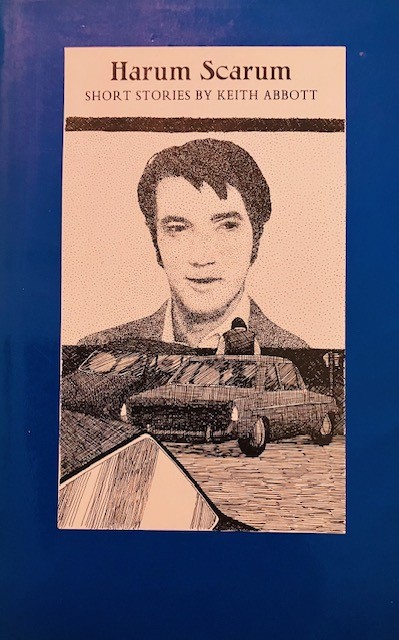
Intending to get that next Substack post up online yet unable to get to the task for weeks, I finally went to my bookcase and found my copy of Harum Scarum. I had already decided in advance that I would defintely not post the final short story from my father’s book. Keith Abbott’s Harum Scarum is made up of six stories and all of them are autobiographical.
“You’re lucky,” a friend said to me. “You have material about your father. I wish I could learn more about my father.”
Well, the materials are not only about my father. In the last story, “Back to Nature,” I am in the picture and so is my mother. Harum Scarum was published by Coffee House Press in 1984. I remember being deeply ashamed of my teenage self as represented in my father’s story. Even thinking about it now, I didn’t really want to reread the story. And I was avoiding the issue: was I such an ungrateful horrible brat back then?
So when I plucked the book off the bookcase, I was still considering which section I would put on Substack. However, my fingers immediately flipped the pages open to the last story. I don’t know why, other than a feeling of facing the inevitable. As I typed my father’s words into Substack, I realized that I had not been ashamed so much of the small section where I said a few things as a grumpy teenager, but what I had been ashamed about was the part about my parents not getting along.
The location of this episode was during a rare moment when the three of us headed out of the city and into the mountains on a camping trip. I remember that particular trip. While it is possible to pin a lot of my aversion behaviour on autism (now that I know), and this could become a pan-occasion excuse, but in this case I think it’s fairly clear: camping provides an excellent opportunity to experience sensory overload. I disliked camping, and still do. I remember the lake, the resort and the mosquitos. It has to be said that this trip was taken during a period when my parents were making an effort to have “family vacations” since my mother discouraged my father and me to interact with other family members. I don’t recall these trips as fun. In fact my presence in the story is very much how it was – me in the back seat of the car and retreating as much as possible.
It always dismayed me how much my mother was attracted to the most unpleasant physical situations. In my father’s story my mother is insisting on camping near the water and my father has warned her once, even twice, of the swarms of mosquitos. And then in a overriding moment of physical anger, he makes it clear that he will not warn her again and takes charge of the situation. No one will contradict him directly. My mother keeps chipping away at taking back control through various tactics, put downs and criticisms and gaslighting. The sense of emasculation is present throughout the story, the deepening anger and misery.
At one point in my life, just before I left the house, my mother decided that she and I should engage in a mother-daughter trip to Mexico. Because she was a bit daunted by the idea of the dangers we might encounter, she invited a Mexican-American friend to accompany us which meant that my mother was on slightly better behaviour. In Ensenada my mother was determined to eat street food. We were walking somewhere near a wharf and she insisted on heading out to the end of the pier which stank of fish to eat her treat. I refused, not only to stand at the end of the pier but to eat street food. During the drive back north my mother sat on an array of plastic diapers laid out over the driver’s seat.
In “Back to Nature” my father describes his childhood, and the pleasure that he experienced as a child. The character Walt returns to the simple fun of taking a swim in a lake without being criticized, neither himself nor the lake. It struck me in particular the scene in which Walt is eating apple pie. My father loved his mother’s apple pie. Even the phrasing of the words about seeing the trees from a garage window in “Back to Nature” reminds me of one of Keith’s poems about his parents’ farm.
I recall that we did experience car problems on the trip, but my father didn’t stay behind at the lake. He didn’t make a friend and get to hang out with someone who appreciated him. We all left together and I believe it was raining. Was I shocked that the character of Walt chose not to go back to his wife or home? I must have read that ending as a betrayal and somehow I felt accountable.
A selection of Keith’s works are available at https://persephoneabbott.substack.com